

The 8(a) Compliance Calendar: A Practical System for Tracking Business Obligations
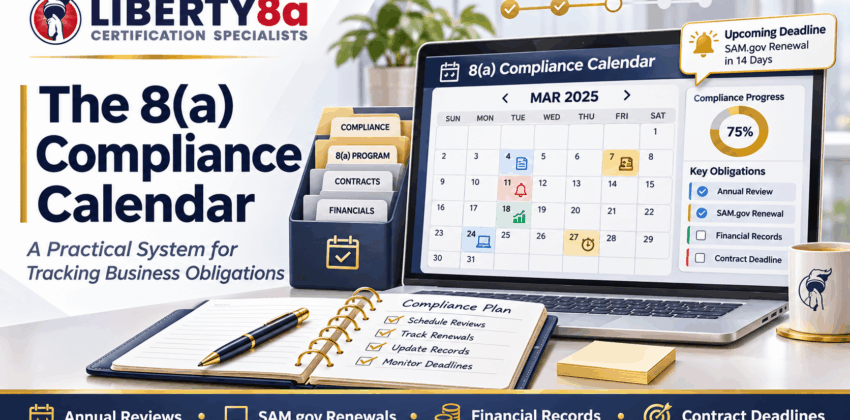
Running a small business involves more than delivering products or services. Owners must also manage renewals, official reviews, financial records, and contract deadlines. Without a reliable tracking system, important tasks can easily be overlooked.
An 8(a) compliance calendar helps businesses organize these responsibilities. Instead of relying on memory, owners can track requirements, assign tasks, and keep proof of completion in one system.
For participants in the SBA 8(a) Business Development Program, staying organized is especially important. This guide explains how to build a practical calendar for certification compliance, registrations, and business obligations.
Why an 8(a) Compliance Calendar Matters
A business can be busy serving customers and still miss an administrative deadline. For example, staff may focus on contract delivery while overlooking a registration renewal or an official request for information.
As a result, the company may face delays or additional compliance concerns. A calendar helps reduce this risk by turning obligations into manageable tasks.
For each task, record the deadline, responsible person, required documents, and completion status. In addition, identify where the final confirmation will be stored.
Most importantly, review the calendar regularly. Do not wait until an official notice arrives to begin preparing.
Track Responsibilities Before Deadlines Arrive
Early planning gives staff more time to collect documents and resolve questions. For example, set an internal preparation date before the actual submission deadline.
However, remember that internal target dates are planning tools. Official deadlines must still be verified using the applicable agency instructions or contract terms.

Separate Your Business Compliance Obligations
Not every business requirement follows the same schedule. Therefore, divide your calendar into separate categories. This makes it easier to monitor each obligation and identify its official source.
SBA 8(a) Annual Review Requirements
SBA 8(a) program participants have ongoing eligibility and annual review responsibilities. These may involve business information, financial documentation, and other materials required by SBA.
Consequently, participants should track their specific annual review instructions, notices, and submission deadlines. The requirements may depend on the firm’s circumstances and current SBA procedures.
For additional information, review official SBA business certification guidance.
SAM.gov Registration Renewals
Businesses that maintain a federal entity registration must also monitor their SAM.gov status. According to SAM.gov, entity registrations must be renewed every 365 days to remain active.
Therefore, record the registration expiration date and plan your renewal process in advance. You should also check whether business information requires updating.
Visit the official SAM.gov Entity Registration page for current instructions.
Tax, Financial, and Licensing Obligations
In addition to federal program requirements, businesses may have tax filings, financial reporting duties, insurance renewals, and professional licensing obligations.
However, the applicable deadlines can vary by business type, location, and activity. For this reason, confirm each requirement with the responsible agency or qualified adviser.
Federal Contract Deliverables
Companies performing government contracts must also monitor contract-specific responsibilities. These may include reports, project milestones, invoices, deliverables, and other requirements stated in the contract.
Importantly, completing an SBA annual review does not automatically satisfy a separate contract reporting requirement. Track these obligations independently.
Assign Task Owners and Keep Supporting Evidence
A calendar becomes more useful when every task has a responsible person. Without clear ownership, important work may be delayed because staff assume someone else is handling it.
First, assign one person to monitor each obligation. Next, identify who will review the supporting documents before completion.
Finally, decide where the official records and completion confirmations will be stored. This creates a clearer process for future reviews.
Information to Record for Every Task
- Task: Describe the specific requirement.
- Category: Identify whether it relates to SBA, SAM.gov, finances, licensing, or contracts.
- Responsible person: Assign the individual managing the task.
- Official due date: Record the verified deadline.
- Internal target date: Set an earlier date for preparation.
- Source: Identify the notice, regulation, or contract provision.
- Reviewer: Assign someone to check the completed work.
- Evidence: Store the final documents and confirmation of completion.
If a deadline changes, retain the official communication explaining that change. Additionally, update the calendar so that staff members use the correct information.

Review the Next 90 Days Every Month
A monthly review helps businesses identify approaching deadlines. Instead of checking only the current week, examine the next 90 days.
For example, review upcoming registration renewals, financial reports, contract milestones, and outstanding government requests. Also consider changes in business ownership or management that may require action.
Then, confirm the status of each task. If supporting documents are missing, assign follow-up responsibilities before the deadline becomes urgent.
Use a Simple 30-, 60-, and 90-Day Review
- Next 30 days: Prioritize approaching deadlines and urgent requests.
- Next 60 days: Begin collecting supporting documents and confirming responsibilities.
- Next 90 days: Identify future renewals, reporting periods, and major contract milestones.
This schedule is an internal planning method, not an official SBA requirement. Therefore, always follow the actual deadline stated by the relevant authority.

Practical 8(a) Compliance Calendar Checklist
Use this checklist to organize your process. It is a practical management tool rather than an official SBA compliance checklist.
- Confirm the current official instructions before acting.
- Identify each obligation and its applicable deadline.
- Separate SBA reviews, SAM.gov registration, financial reporting, and contract requirements.
- Assign a responsible person for every important task.
- Set internal preparation and review dates.
- Keep supporting records for important decisions and submissions.
- Save confirmation receipts and official notices.
- Use accurate, consistent information across business records and registrations.
- Update deadlines when an authorized change is communicated.
- Review upcoming obligations at least once a month.
- Ask a qualified professional when legal, accounting, or eligibility questions are unclear.
After completing the checklist, review how your team will maintain the calendar. A system works best when it is updated regularly and employees understand their responsibilities.
Common Compliance Calendar Mistakes to Avoid
Even a detailed calendar can become unreliable if business information is not maintained. For this reason, review your process for common weaknesses.
Relying Only on Email Reminders
Official notices are important, but they should not be your only tracking method. Instead, maintain an internal schedule based on verified requirements.
Using One Deadline for Different Requirements
SBA program reviews, SAM.gov renewals, and contract deliverables may follow different schedules. Therefore, record each requirement separately and verify its specific deadline.
Failing to Save Proof of Completion
Marking a task complete is not the same as keeping evidence that it was completed. Save submission confirmations, approvals, correspondence, and other relevant records.
Key Takeaway: Make Compliance an Ongoing Process
A practical 8(a) compliance calendar helps businesses turn important requirements into organized, assigned, and documented tasks.
By separating obligations, reviewing upcoming deadlines, and retaining supporting evidence, owners can make compliance activities easier to manage.
Ultimately, a calendar is only as reliable as the information entered into it. Therefore, verify official requirements regularly and update your system whenever circumstances change.
How LIBERTY8a Can Help
Maintaining SBA 8(a) certification involves ongoing responsibilities. Business owners may benefit from assistance understanding annual reviews, required documentation, and other certification-related obligations.
LIBERTY8a offers 8(a) Annual Review Services to help participating firms prepare and organize annual review materials.
To discuss your circumstances and available services, call (813) 784-0066 or visit the LIBERTY8a Contact page.
Call LIBERTY8a: (813) 784-0066
Certification and contract award decisions are made by the relevant government authorities. No consultant can guarantee SBA approval or a federal contract award.
Official Resources
SBA Business Certifications: Review official SBA program and annual certification guidance.
SAM.gov Entity Registration: Review current registration and renewal instructions.
Editorial Review Date: November 18, 2026.
Editorial Disclaimer: This article provides general educational information. It is not legal, tax, accounting, or government advice. Requirements and deadlines may change. Always verify current official instructions and consult qualified professionals when appropriate.