


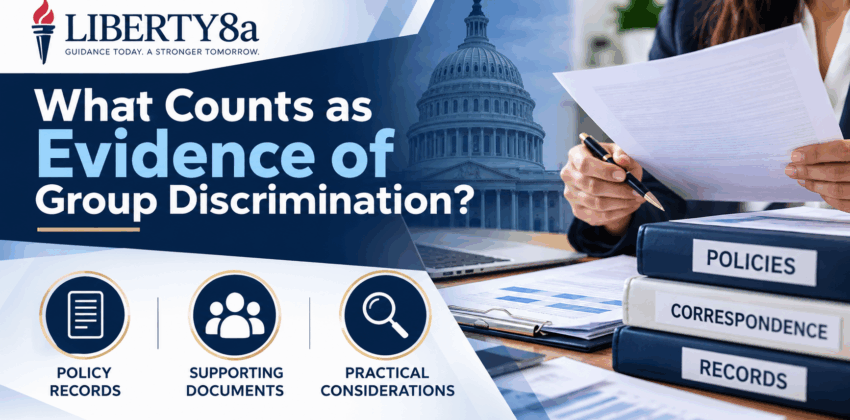
What Counts as Evidence of Group Discrimination?
October 22, 2026 | SBA 8(a) Certification
Understanding how documentary evidence, policy records,
and reliable supporting information may contribute
to an SBA 8(a) social disadvantage showing.

is an important starting point for documentation review.
An important starting point is identifying the underlying
action—not merely the applicant’s reaction to it. The
attached 2026 framework discusses actions by government
bodies, universities, corporations, and private entities.
For owners exploring the
SBA 8(a) Business Development Program,
the difference between a persuasive personal account and
an evidence-supported showing matters. The August 2026
rule addresses social disadvantage for individually
owned firms and describes an identifiable-group,
membership, and material-harm framework. The discussion
below focuses on practical understanding, not a prediction
about any particular application.
Distinguish a Policy from a Conclusion
Consider whether a record is contemporary, authentic,
complete, and relevant. A newspaper article, a policy
excerpt, and an individual email may answer different
questions. None should be treated as automatically
conclusive.
The question is not simply whether an experience was
difficult, but whether the record supports the applicable
legal elements. A structured review helps business owners
prioritize relevant facts without losing the context of
their experience.
Three Questions for Reviewing Evidence
Is It Reliable?
Check the source, date, authenticity, and completeness.
Is It Relevant?
Identify which specific claim or element the record supports.
Is It Sufficient?
Recognize what the record does not establish and what remains uncertain.
Where Documentary Evidence May Exist
A public policy notice can establish what a policy said,
but not necessarily how it was applied to one applicant.
Pair policy records with individual correspondence and
relevant timelines where available.
Applicants can improve clarity by arranging documents
in chronological order and describing each source in
neutral terms. Context matters: a record may support
one element while leaving another unresolved.

records may help establish a clearer factual timeline.
Evaluate Reliability and Context
A useful next step is to create a short fact sheet
identifying the source, the date, what it actually
proves, and what it does not prove. Separate documented
facts from interpretations. When a key link cannot be
substantiated, acknowledge the uncertainty rather
than overstating the case.
This is a preparation method, not a substitute for
the precise rule text or SBA instructions. Every
application turns on its own facts and the applicable
eligibility criteria.

verified facts from interpretations.
Practical Questions to Ask Before Moving Forward
-
What specific action or practice is at issue,
and when did it occur? -
What reliable evidence identifies the affected
group and my connection to it? -
What material consequence can I substantiate,
and how does it connect to the action?
Key Takeaway
A well-organized application distinguishes
group-level evidence, individual membership,
and material harm.
Avoid treating examples as automatic eligibility
rules, and check current SBA guidance before
submitting materials.
How LIBERTY8a Can Help
Preparing an SBA 8(a) application can involve
detailed documentation and careful review.
Contact LIBERTY8a to discuss certification assistance.
Explore SBA 8(a) Certification Services
No service can guarantee SBA approval.
Regulatory Reference
Federal Register, August 11, 2026,
91 FR 51568–51573.
Read the official Federal Register publication
.