

Preparing for the Future of SBA 8(a) Certification
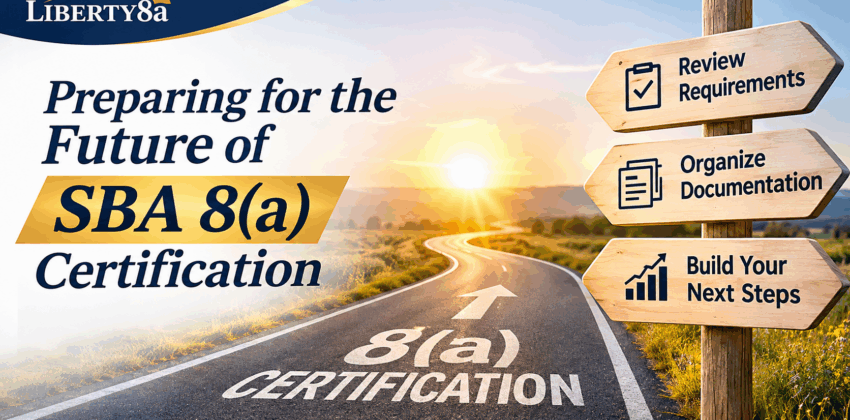
For businesses considering SBA 8(a) certification, preparation begins with understanding the current requirements. Rather than relying on an old application template, business owners should review the rules and organize their records accordingly.
If you want to prepare for 8(a) certification 2026, start by examining your eligibility, supporting evidence, and business records. Taking these steps early can help you identify issues before submitting an application.
The August 2026 SBA rule introduced changes to how individuals establish social disadvantage. In particular, the rule removed the previous group-based presumption for individually owned firms. Instead, applicants must provide evidence that supports the applicable requirements.
However, social disadvantage is only one part of the SBA 8(a) Business Development Program. Business owners must also consider other eligibility requirements. This article explains practical ways to prepare under the updated framework without predicting any particular application outcome.

Plan Around the Current SBA 8(a) Rule
The first step is to understand the requirements that apply to your business. Although older guides may provide background information, they may not reflect the latest SBA regulations.
For example, the August 2026 final rule changed the standard for establishing social disadvantage for individually owned firms. It also identifies the importance of group-level evidence, individual membership, and material harm.
Therefore, applicants should review current SBA instructions instead of assuming that previous examples or application methods remain sufficient.
Understand the Evidence Requirements
Under the revised framework, an applicant may need to demonstrate that a relevant government or private entity discriminated against or showed bias toward an identifiable group. The applicant must also establish the required connection to that group and the resulting material harm.
To begin, identify the relevant action or policy. Next, review reliable sources that may support the group-level showing. Finally, consider how the action affected the applicant and whether the required harm can be substantiated.
Importantly, a personal account alone may not establish every required element. Supporting evidence and accurate explanations remain essential.
Preparation Tip: Review the current regulations before organizing your evidence. This helps ensure that your application addresses the applicable legal requirements rather than an outdated narrative format.
Review Other Eligibility Requirements Separately
Establishing social disadvantage does not automatically make a business eligible for the SBA 8(a) program. Applicants must also satisfy other requirements.
For this reason, business owners should evaluate each eligibility area independently. A strong explanation of social disadvantage cannot replace missing ownership, financial, or business information.
Business Ownership and Control
First, examine the ownership and management structure of your business. The general requirements for individually owned firms include at least 51% ownership and control by qualifying socially and economically disadvantaged U.S. citizens.
Additionally, review company agreements and other relevant records. These documents should accurately reflect who owns the business and who controls its operations.
Economic Disadvantage and Business Size
Next, review the financial information relevant to economic disadvantage. SBA considers applicable financial thresholds and other eligibility factors. Therefore, applicants should check current limits rather than relying on outdated figures.
Business size also matters. A company must qualify as a small business under the appropriate SBA size standard. Consequently, owners should verify the classification that applies to their business activities.
Business Readiness and Other Criteria
Finally, evaluate whether your business satisfies the program’s additional requirements. These may involve business history, potential for success, good character, and previous program participation.
Preparing early can reduce confusion. However, early preparation does not replace verifying current SBA guidance or seeking professional advice when necessary.

Organize Documentation Before Applying
Once you understand the requirements, begin organizing your records. A clear documentation system makes information easier to locate and review.
For example, keep relevant business documents, financial records, and supporting evidence in clearly labeled folders. Where appropriate, arrange records chronologically.
In addition, review the source and date of each important document. Ask what the record establishes and whether it supports the statement you intend to make.
Identify Missing or Unclear Information
A useful next step is to create a short fact sheet for important events or claims. Include the date, source, relevant facts, and any unanswered questions.
For instance, a record may confirm that an event occurred. However, it may not establish the cause of that event or its material consequences.
When a key connection remains unclear, acknowledge the uncertainty. Then, determine whether legitimate corroborating evidence is available. Avoid reconstructing missing details through guesswork.
Build a Responsible Next-Step Checklist
Preparing an application involves several decisions. Therefore, using a simple checklist can help business owners remain organized and focused.
The following checklist is a practical preparation tool. It is not an official SBA application checklist.
SBA 8(a) Certification Preparation Checklist
- Review the current SBA 8(a) eligibility requirements.
- Understand the updated social disadvantage framework.
- Identify relevant group-level evidence and individual membership.
- Review any material harm that can be substantiated.
- Verify the business ownership and control structure.
- Check economic disadvantage requirements and financial records.
- Confirm the applicable SBA business size standard.
- Review other eligibility criteria and business readiness.
- Organize documents and supporting information.
- Identify missing records, unclear facts, and inconsistencies.
- Consult official SBA guidance before submitting an application.
After completing this review, identify the areas that need additional attention. As a result, you can prioritize preparation instead of rushing through unfamiliar requirements.

Practical Questions to Ask Before Moving Forward
Before submitting an application, consider the following questions. They can help identify whether your evidence is complete and whether your business is ready to proceed.
- What specific discriminatory action or practice is at issue, and when did it occur?
- What reliable evidence identifies the affected group and my connection to it?
- What material consequence can I substantiate, and how does it connect to the action?
- Does my business meet the applicable ownership, control, size, and economic disadvantage requirements?
- Have I reviewed the latest SBA instructions and identified any missing information?
Key Takeaway
To prepare for 8(a) certification 2026, business owners should focus on understanding current requirements, organizing reliable documentation, and reviewing eligibility carefully.
In particular, a well-organized application should distinguish group-level evidence, individual membership, and material harm. At the same time, applicants must independently verify the program’s other eligibility requirements.
Ultimately, responsible preparation is more valuable than rushing into an outdated template. Before submitting materials, review official SBA guidance and seek qualified assistance when appropriate.
How LIBERTY8a Can Help
Preparing an SBA 8(a) application can involve detailed documentation and careful review. Business owners may benefit from assistance in understanding the certification process and preparing supporting materials.
LIBERTY8a provides certification assistance to business owners. To discuss available services, call (813) 784-0066 or visit LIBERTY8a.
Call us: (813) 784-0066
No service can guarantee SBA approval.
Official Sources and Additional Guidance
Regulatory Source: Federal Register, August 11, 2026, 91 FR 51568–51573. Read the official final rule.
Additional SBA Guidance: SBA 8(a) Business Development Program.
Disclaimer: This article provides general educational information and does not constitute legal advice. Applicants should review current SBA regulations, official instructions, and applicable eligibility requirements. Certification approval is not guaranteed.