


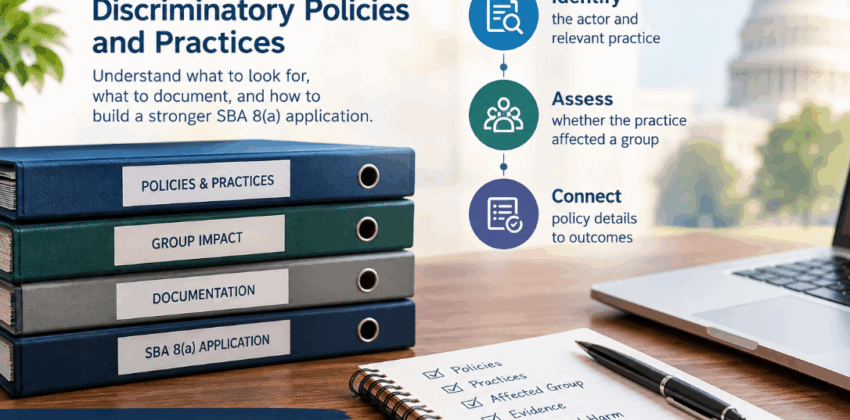
Identifying Relevant Discriminatory Policies and Practices
October 27, 2026 | SBA 8(a) Certification

Why Identifying the Relevant Practice Matters
Some applicants focus entirely on one unpleasant interaction. However, the 2026 framework directs attention to an identifiable action, policy, rule, regulation, or practice affecting a group.
For owners exploring the SBA 8(a) Business Development Program, the difference between a personal account and an evidence-supported showing matters. The August 2026 rule describes a framework involving an identifiable group, individual membership, and material harm.
Therefore, applicants should look beyond a single event and examine the broader circumstances. The goal is to identify the relevant practice, understand who it affected, and determine whether reliable records support the connection to individual harm.
This article explains practical documentation considerations. It does not predict the outcome of an individual application or guarantee eligibility.
Step 1: Identify the Actor and Relevant Practice
Begin by identifying the person, organization, institution, or other actor connected to the practice being examined. Next, describe the specific action, policy, rule, regulation, or practice involved.
Be as precise as possible. For example, instead of writing that an organization treated people unfairly, explain what decision it made, what procedure it followed, or what requirement it applied.
Distinguish a Specific Practice from a General Concern
Applicants should avoid assuming that every diversity initiative, hiring target, or difference in outcomes proves qualifying discrimination. These circumstances require careful examination of the relevant facts, applicable law, and supporting evidence.
Similarly, one unpleasant interaction may not explain the full circumstances. Consider whether the event was connected to a broader policy or practice, and identify records that may help establish that connection.
As a result, a clear description should identify the actor, the action, the time period, and the available evidence. This approach helps keep the discussion focused on facts rather than unsupported conclusions.
What Should You Identify?
Use these questions when reviewing a policy or practice.
01
The Actor
Who created, adopted, or applied the practice?
02
The Practice
What specific policy, rule, decision, or action is involved?
03
The Time Period
When was the practice introduced, applied, or changed?
04
The Evidence
Which reliable records support the description?
These are practical review questions, not an official SBA checklist.
Step 2: Assess Whether the Practice Affected a Group
After identifying the practice, consider the group that may have been affected. Applicants should describe the group carefully and explain the available evidence supporting that description.
Institutional practices may appear in written policies, official procedures, internal communications, public records, or other reliable sources. However, not every record will establish the same facts.
Look for Reliable and Relevant Records
For example, a written policy may show how an organization described its procedures. Meanwhile, correspondence or dated decisions may help explain how the policy was applied in a particular situation.
In addition, records from different periods may reveal whether a practice remained in place, changed, or was applied differently over time. Applicants should record the source and date of each document to preserve its context.
Remember that a document showing the existence of a policy does not automatically prove that the policy affected a particular group. The applicant must examine what the record actually establishes and whether other evidence is needed.

Step 3: Connect Policy Details to Individual Outcomes
Identifying a policy or practice is only part of the review. Applicants should also examine how the relevant circumstances connect to their own experiences and any claimed material harm.
To begin, identify the specific event or decision that affected you. Then, explain how it relates to the practice and the group discussed in your documentation.
Separate Documented Facts from Interpretations
A useful next step is to create a short fact sheet for each important record. Include the source, date, relevant information, and the specific point the document may support.
Additionally, explain what the record does not establish. For instance, a policy document may show that a procedure existed, but it may not show how that procedure affected a particular individual.
When a key connection cannot be substantiated, acknowledge the uncertainty rather than overstating the case. This distinction helps keep the application accurate and makes it easier to identify areas that may need further review.
Ultimately, the goal is to explain the relationship between the practice, the affected group, individual membership, and the claimed material harm using reliable information.

Example: A Simple Policy Evidence Index
Use this sample structure to organize information. Adapt it to your circumstances and the records available.
| Review Area | Information to Record |
|---|---|
| Actor | Person, organization, or institution involved |
| Policy or Practice | Description of the action, rule, or procedure |
| Date | Date introduced, applied, or relevant |
| Affected Group | Group identified in the available evidence |
| Supporting Record | Document, correspondence, or other reliable source |
| Individual Impact | Relevant personal consequence and supporting information |
| Open Questions | Missing information or points requiring clarification |
This is an illustrative organizational tool, not an official SBA form or required submission format.
Practical Questions to Ask Before Moving Forward
Before relying on a particular policy or practice in an application, review the available information. The following questions can help identify gaps and clarify the evidence.
- Identify the practice: What specific action, policy, or procedure is involved, and when did it occur?
- Examine the group: What reliable evidence identifies the affected group and my connection to it?
- Review the records: Which documents support the description, and what limitations do they have?
- Assess individual impact: What material consequence can I substantiate, and how does it connect to the action?
If an answer remains unclear, record the issue in your evidence index. Then, determine whether additional documents, context, or professional guidance may help address the question.
Key Takeaway
Identifying a relevant discriminatory policy or practice requires more than describing an unpleasant experience.
Applicants should examine the specific actor, action, affected group, available records, and connection to individual material harm.
In summary, use reliable documentation, maintain a clear chronology, and separate established facts from interpretations. Most importantly, avoid treating examples as automatic eligibility rules and review current SBA guidance before submitting an application.
How LIBERTY8a Can Help
Preparing an SBA 8(a) application can involve detailed documentation and careful review. If you need assistance, contact LIBERTY8a to discuss its certification services and application preparation support.
Explore SBA 8(a) Certification Services
Visit
LIBERTY8a.com
for additional information.
No service can guarantee SBA approval.
Regulatory Reference
Federal Register, August 11, 2026, 91 FR 51568–51573.
Read the Federal Register publication
.