

How the Ultima Decision Changed 8(a) Eligibility Reviews
October 25, 2026 | SBA 8(a) Certification
Understanding the 2023 court decision, SBA’s response,
and the later changes to social disadvantage reviews.

in SBA 8(a) social disadvantage determinations.
The shift in SBA 8(a) social disadvantage
documentation did not happen in isolation.
A 2023 federal district court decision in
Ultima Services Corp. v. USDA challenged
SBA’s use of a rebuttable racial presumption.
On July 19, 2023, the court held that SBA’s use
of the presumption violated the plaintiff’s
Fifth Amendment equal protection rights and
prohibited SBA from continuing to use it
in administering the program.
For owners exploring the
SBA 8(a) Business Development Program,
the difference between a persuasive personal account
and an evidence-supported showing matters.
The August 2026 rule addresses social disadvantage
for individually owned firms and describes an
identifiable-group, membership, and material-harm
framework.
The discussion below focuses on practical
understanding, not a prediction about
any particular application.
The 2023 Decision in Context
Before the court’s decision, SBA regulations
included a rebuttable presumption of social
disadvantage for individuals belonging to
certain racial and ethnic groups.
The court determined that the use of this
presumption was unconstitutional and enjoined
SBA from relying on it. The decision addressed
the presumption rather than eliminating the
entire 8(a) Business Development Program.
SBA’s August 2026 final rule states that
individuals already determined to be socially
disadvantaged generally do not need to
establish that status again, while individually
owned firms not yet admitted must satisfy
the revised requirements. Entity-owned firms
are outside the scope of this particular change.
The question is not simply whether an
experience was difficult, but whether
the record supports the applicable legal
elements. A structured review helps business
owners prioritize relevant facts without
losing the context of their experience.
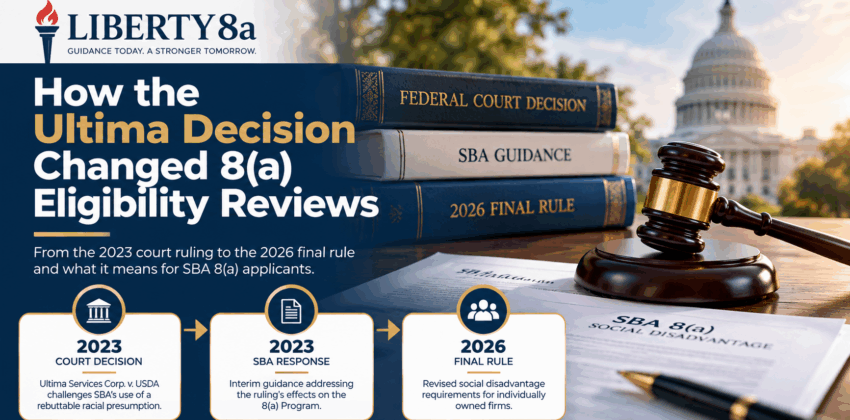
Timeline: From Ultima to the 2026 Rule
Three distinct developments shaped the
evolution of SBA 8(a) eligibility reviews.
2023
Court Decision
The federal district court enjoins
SBA’s use of the rebuttable racial
presumption of social disadvantage.
2023
Interim SBA Response
SBA issues interim guidance
addressing the ruling’s effects
on program participants,
applicants, and federal agencies.
2026
Final Rule
SBA publishes a final rule
addressing social disadvantage
requirements for individually
owned firms.
The court ruling, administrative guidance,
and final rule are separate legal
and administrative developments.
What SBA Did Afterward
Following the July 2023 ruling, SBA issued
interim guidance addressing how the
8(a) Program would continue operating
without reliance on the enjoined presumption.
The court decision did not itself create
the 2026 final rule. Keeping the court
decision, SBA’s interim administrative
response, and the later rulemaking
separate prevents confusing timelines.
Applicants can improve clarity by arranging
documents in chronological order and
describing each source in neutral terms.
Context matters: a record may support
one element while leaving another unresolved.

business owners prepare more informed
documentation strategies.
What Changed in the Final Rule
The August 2026 final rule formalized
changes to the social disadvantage
framework for individually owned firms
seeking admission to the SBA 8(a) Program.
Under the framework discussed in the rule,
applicants should pay careful attention
to the relationship between an identifiable
group, membership in that group, and
individual material harm.
A useful next step is to create a short
fact sheet identifying the source, the
date, what it actually proves, and
what it does not prove.
Separate documented facts from interpretations.
When a key link cannot be substantiated,
acknowledge the uncertainty rather
than overstating the case.
This is a preparation method, not a
substitute for the precise rule text
or SBA instructions. Every application
turns on its own facts and the
applicable eligibility criteria.

can help distinguish supported facts
from assumptions.
Understanding the Shift in Review
Earlier Presumption
SBA previously presumed social
disadvantage for individuals
belonging to specified racial
and ethnic groups, subject
to rebuttal.
Individualized Review
The revised framework emphasizes
establishing the applicable elements
of social disadvantage through
an individualized showing.
This comparison summarizes the general
shift and does not replace the rule’s
specific applicability provisions.
Practical Questions to Ask Before Moving Forward
-
What specific action or practice is at issue,
and when did it occur? -
What reliable evidence identifies the
affected group and my connection to it? -
What material consequence can I substantiate,
and how does it connect to the action?
Key Takeaway
The Ultima decision marked an important
shift away from SBA’s use of the
rebuttable racial presumption.
The subsequent administrative response
and 2026 rulemaking should be understood
as separate developments.
A well-organized application distinguishes
group-level evidence, individual membership,
and material harm. Avoid treating examples
as automatic eligibility rules, and check
current SBA guidance before submitting materials.
How LIBERTY8a Can Help
Preparing an SBA 8(a) application can involve
detailed documentation and careful review.
Contact LIBERTY8a to discuss certification assistance.
Explore SBA 8(a) Certification Services
Visit
LIBERTY8a.com
for additional information.
No service can guarantee SBA approval.
Sources and Regulatory References