

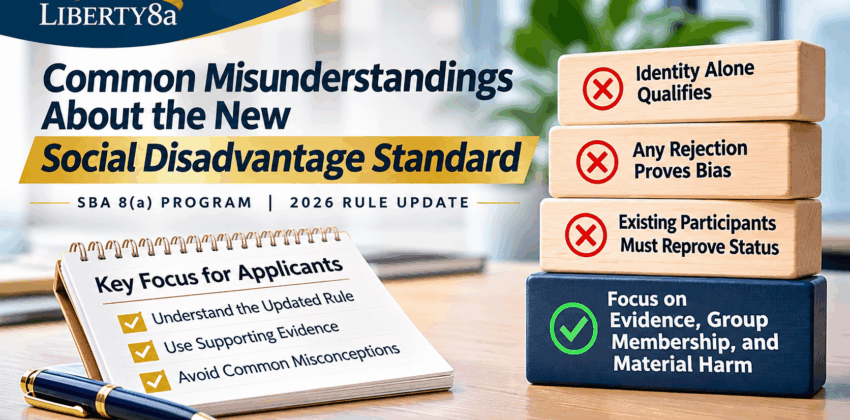
Common Misunderstandings About the New Social Disadvantage Standard
Rule changes can create confusion, especially
when older articles and sample narratives
remain online. As a result, business owners
may find conflicting information about
the SBA 8(a) Business Development Program.
Understanding common
2026 8(a) social disadvantage
misconceptions can help applicants
prepare more effectively. In particular,
owners should understand how the updated
requirements affect individually owned
businesses.
The August 2026 final rule removes the
previous presumption of social disadvantage
for members of certain groups. Instead,
individuals must provide evidence that
supports the applicable requirements.
Furthermore, the framework considers
identifiable-group membership and
material harm. The following discussion
explains important distinctions and
practical documentation considerations.
However, it does not predict whether
any particular application will qualify.

requirements can help business owners
prepare more informed applications.
Misunderstanding 1: Identity Alone Qualifies
One common misunderstanding is that
belonging to a particular racial or
ethnic group automatically establishes
social disadvantage.
However, the August 2026 final rule
removes the previous group-based
presumption for individually owned
businesses. Therefore, applicants
cannot rely on identity alone to
establish social disadvantage.
Instead, the rule provides an
evidence-based standard for individual
American citizens. Applicants must
support the required elements with
relevant facts and documentation.
What Applicants Should Understand
First, identify the group involved
in the alleged discriminatory practice.
Next, explain the applicant’s membership
in that group at the relevant time.
Finally, describe the material harm
and the evidence supporting it.
Importantly, establishing social
disadvantage is only one part of
the broader SBA 8(a) eligibility
process. Applicants must also
satisfy other applicable program
requirements.
Important Reminder:
Group membership alone does not
guarantee eligibility. An applicant
should understand the evidence
required under the current rule
and the program’s other
eligibility standards.
Misunderstanding 2: Any Rejection Proves Bias
Another misconception is that every
rejected application, missed opportunity,
or unsuccessful business decision
proves discrimination.
However, an unfavorable result
does not automatically establish
discrimination or material harm
under the applicable standard.
The relevant facts and their
connection to the alleged
discriminatory practice matter.
For example, a business owner may
have been denied a contract or
professional opportunity. That
outcome may be important.
Nevertheless, the applicant
would still need evidence
connecting the outcome to
the relevant discriminatory
action or policy.
Why Supporting Evidence Matters
First, identify the specific
action or policy involved.
Next, determine whether reliable
records support the claim.
Then, explain how the alleged
conduct materially affected
the applicant.
In addition, applicants can
arrange supporting documents
chronologically. This helps
clarify the sequence of events
and makes inconsistencies
easier to identify.

distinguish an unfavorable outcome
from a substantiated claim
of discrimination.
Misunderstanding 3: Existing Participants Must Automatically Reprove Their Status
Changes to eligibility rules
can also raise questions among
businesses already participating
in the SBA 8(a) program.
One important distinction is the
difference between a pending
application and an existing
program participant.
The August 2026 final rule
expressly applies to individually
owned applications pending on
September 10, 2026. However,
that provision should not be
interpreted as an automatic
requirement for every existing
participant to submit an entirely
new social disadvantage application.
Continuing Eligibility Still Matters
Existing participants remain
responsible for complying
with applicable SBA program
requirements. For example,
participating firms have
ongoing eligibility and
annual review obligations.
Therefore, business owners
should monitor official SBA
communications and respond
to any documentation requests
that apply to their firms.
Additionally, participants
should keep important records
accurate and organized.
If SBA requests further
information, the business
should review the request
carefully and follow the
applicable instructions.

attention to SBA requirements
help businesses maintain
organized certification files.
How to Avoid Common Documentation Mistakes
Understanding the rule is
only the first step.
Applicants should also
review the quality of
their supporting records.
To begin, create a short fact
sheet for each important event.
Include the date, source,
relevant action, and
documented consequence.
Next, separate confirmed facts
from assumptions. For example,
a record may establish that
an event occurred without
proving why it happened.
Finally, acknowledge missing
information honestly. If an
important connection remains
unclear, seek legitimate
corroboration rather than
overstating the evidence.
Practical Questions to Ask Before Moving Forward
Before preparing an SBA 8(a)
application, consider these
three questions.
-
What specific action or
practice is at issue,
and when did it occur? -
What reliable evidence
identifies the affected
group and my connection
to it? -
What material consequence
can I substantiate,
and how does it connect
to the action?
Key Takeaway
Understanding common
2026 8(a) social
disadvantage misconceptions
can help applicants avoid
unsupported assumptions.
A well-organized application
distinguishes group-level
evidence, individual membership,
and material harm.
Therefore, applicants should
focus on reliable documentation
and current SBA requirements
rather than outdated examples
or automatic eligibility claims.
How LIBERTY8a Can Help
Preparing an SBA 8(a)
application can involve
detailed documentation
and careful review.
As a result, business
owners may benefit
from guidance on
certification preparation
and applicable requirements.
LIBERTY8a offers
certification assistance
to business owners.
To discuss available
services, call
(813) 784-0066
or visit
LIBERTY8a
.
Explore Our SBA 8(a) Certification Services
Call us:
(813) 784-0066
No service can guarantee SBA approval.
Regulatory Source:
Federal Register, August 11, 2026,
91 FR 51568-51573.
Read the Official Final Rule
.
Additional SBA Guidance:
SBA Certification and Eligibility Information
.
Disclaimer: This article
provides general educational
information and does not
constitute legal advice.
Applicants should review
current SBA regulations,
official instructions,
and applicable eligibility
requirements. No specific
outcome or certification
approval is guaranteed.