


Reviewing Your Social Disadvantage Documentation Before Submission
Before submitting an SBA 8(a) application, take a final look at your supporting evidence. Does your documentation present a clear, consistent, and verifiable explanation? More importantly, can a reviewer understand how the facts support your application?
A final review involves more than correcting grammar or organizing documents. It also requires checking dates, verifying statements, and identifying gaps in supporting evidence. Therefore, using an 8(a) evidence review checklist can make this process more manageable.
For business owners exploring the SBA 8(a) Business Development Program, the difference between a personal account and an evidence-supported explanation matters. The August 2026 rule describes requirements involving identifiable groups, individual membership, and material harm.
As a result, applicants should understand how their records relate to the applicable requirements. This article explains practical ways to review documentation before submission. However, it does not predict the outcome of any application.

Check Each Link in the Showing
First, read your draft as a careful and objective reviewer would. Ask whether each important statement is supported by reliable information.
For example, your explanation should identify what happened, who was involved, and when the action occurred. In addition, it should explain which group was affected and how the action applied to you.
Next, consider the resulting harm. What material consequence can you document? How does that consequence connect to the action or practice described in your application?
Remember that a difficult experience does not automatically establish every required element. Instead, the evidence must support the relevant facts and connections under the applicable rule.
Questions to Review
Before moving forward, make sure your documentation addresses these essential questions:
- What specific action or policy occurred?
- Who was responsible for the action?
- When and where did it happen?
- Which identifiable group was affected?
- How did the action apply to the applicant?
- What material harm can be substantiated?
- What reliable documents support the explanation?
Practical Review Tip: Follow the evidence from the original action to the documented consequence. If an important connection is missing, identify the gap instead of assuming the reviewer will make that connection.
Test Dates, Documents, and Consistency
After reviewing the main explanation, check the supporting records. Each important claim should have a reliable source whenever evidence is required.
Begin by examining the dates. Do they match the events described in your explanation? Can a reviewer understand the timeline without making assumptions?
Next, compare the documents with your written statements. For example, an email may confirm when an event happened. However, it may not explain why the event occurred. That distinction matters.
Additionally, arrange the records in chronological order when helpful. This makes it easier to identify conflicting dates, missing details, or statements that need clarification.

Organize Your Supporting Records
A simple document index can improve clarity. For each record, note its date, source, description, and purpose.
Most importantly, describe what the record actually supports. Do not present assumptions as established facts. If a document supports only part of the explanation, say so clearly.
Prepare for Clarifying Questions
Even a carefully prepared application may contain facts that require additional explanation. Therefore, applicants should review areas that might raise questions.
One useful approach is to prepare a short fact sheet for each important event. Include the source, date, and facts supported by the available evidence.
In addition, identify what remains uncertain. For example, a document may establish that an unfavorable decision occurred. However, it may not prove that the decision resulted from discrimination.
If an important connection cannot be substantiated, acknowledge that limitation. Then, determine whether legitimate corroborating evidence is available. Avoid creating or changing details simply to strengthen the explanation.
Keep Facts and Interpretations Separate
Firsthand observations, official records, and third-party reports may serve different purposes. Consequently, applicants should identify where each statement comes from.
This approach helps maintain accuracy while preserving the context of the applicant’s experience. It also prepares applicants to respond more clearly if further information is requested.

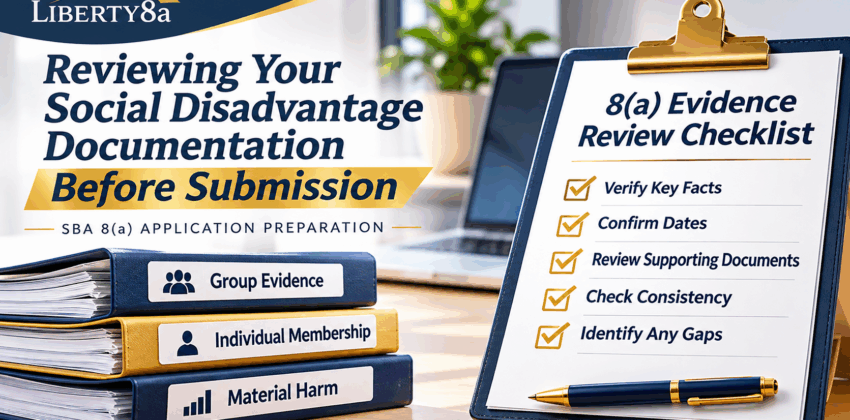
Your 8(a) Evidence Review Checklist
Before submitting your application, use this practical checklist to review your documentation. It is an organizational tool, not an official SBA checklist.
Final Documentation Review
- The action or practice is clearly identified.
- Relevant dates and circumstances are accurate.
- The affected group and individual membership are explained.
- Material harm is described and supported.
- Important statements have appropriate supporting sources.
- Dates and descriptions are consistent across documents.
- Documented facts are separated from interpretations.
- Missing information and uncertainties are acknowledged.
- Current SBA instructions and other eligibility requirements have been reviewed.
Practical Questions to Ask Before Moving Forward
Finally, consider these three questions before moving forward. They can help identify whether important details need further review.
- What specific action or practice is at issue, and when did it occur?
- What reliable evidence identifies the affected group and my connection to it?
- What material consequence can I substantiate, and how does it connect to the action?
Key Takeaway
A thorough 8(a) evidence review checklist helps applicants distinguish group-level evidence, individual membership, and material harm. More importantly, it encourages accurate documentation and consistent explanations.
Before submission, verify current SBA requirements and avoid treating examples as automatic eligibility rules.
How LIBERTY8a Can Help
Preparing an SBA 8(a) application can involve detailed documentation and careful review. As a result, business owners may benefit from understanding the requirements before submission.
LIBERTY8a provides certification assistance to business owners. To discuss available services, contact LIBERTY8a at (813) 784-0066 or visit LIBERTY8a.
Call us: (813) 784-0066
No service can guarantee SBA approval.
Regulatory Source: Federal Register, August 11, 2026, 91 FR 51568–51573. Read the Official Federal Register Document.
Additional SBA Guidance: SBA Certification and Eligibility Information.
Disclaimer: This article provides general educational information and does not constitute legal advice. Applicants should review current SBA regulations, official instructions, and applicable eligibility requirements. Certification approval is not guaranteed.