


Establishing Group Membership at the Relevant Time
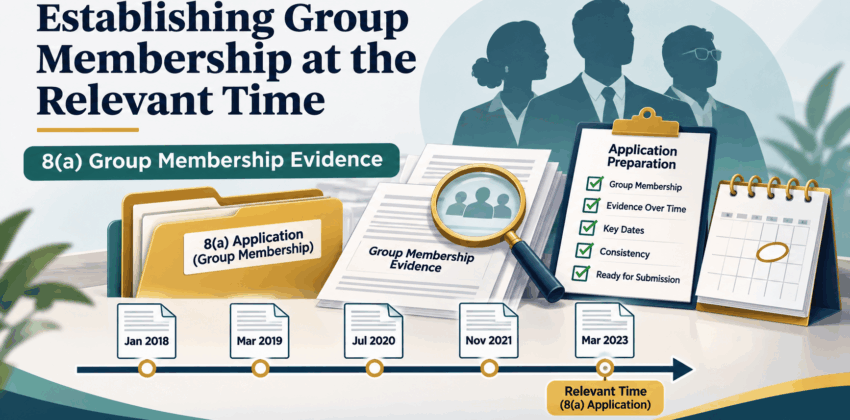
Timing matters. Under the framework described in the
2026 rule, an applicant must establish membership in
the relevant identifiable group when the discriminatory
action or policy occurred.
For owners exploring the SBA 8(a) Business Development
Program, the difference between a persuasive personal
account and an evidence-supported showing matters.
The August 2026 rule addresses social disadvantage
for individually owned firms and describes an
identifiable-group, membership, and material-harm
framework. The discussion below focuses on practical
understanding, not a prediction about any particular
application.

important part of SBA 8(a) application preparation.
Why Timing Matters
A timeline can show whether the applicant belonged
to the affected group when the practice occurred.
If records are missing, identify the gap and seek
legitimate corroboration; do not reconstruct dates
from guesswork.
The question is not simply whether an experience was
difficult, but whether the record supports the
applicable legal elements. A structured review helps
business owners prioritize relevant facts without
losing the context of their experience.

an accurate timeline of relevant events.
Records That May Help Establish Membership
For a practice occurring during a particular year,
documents from that period may be more relevant
than documents created much later. An applicant
should explain changes in circumstances rather
than obscure them.
Applicants can improve clarity by arranging
documents in chronological order and describing
each source in neutral terms. Context matters:
a record may support one element while leaving
another unresolved.
Documentation Tip:
Organize available records chronologically,
preserve their original dates, and clearly
explain the specific facts that each document
supports. Avoid drawing conclusions beyond
what the evidence actually establishes.
How to Resolve Gaps Honestly
A useful next step is to create a short fact
sheet identifying the source, the date, what
it actually proves, and what it does not prove.
Separate documented facts from interpretations.
When a key link cannot be substantiated,
acknowledge the uncertainty rather than
overstating the case.
This is a preparation method, not a substitute
for the precise rule text or SBA instructions.
Every application turns on its own facts and
the applicable eligibility criteria.

can help identify gaps and clarify the facts.
Practical Questions to Ask Before Moving Forward
Before moving forward with an SBA 8(a)
application, consider the following questions:
-
What specific action or practice is at issue,
and when did it occur? -
What reliable evidence identifies the affected
group and my connection to it? -
What material consequence can I substantiate,
and how does it connect to the action?
Key Takeaway
A well-organized application distinguishes
group-level evidence, individual
membership, and material harm.
Avoid treating examples as automatic eligibility
rules, and check current SBA guidance before
submitting materials.
How LIBERTY8a Can Help
Preparing an SBA 8(a) application can involve
detailed documentation and careful review.
Contact LIBERTY8a at
(813) 784-0066
or visit our website to discuss
certification assistance.
Explore Our 8(a) Certification Services
Call us:
(813) 784-0066
No service can guarantee SBA approval.
Regulatory Source:
Federal Register, August 11, 2026,
91 FR 51568-51573.
View the Federal Register document
.
Disclaimer: This article provides general
educational information and should not be
considered legal advice. Applicants should
review current SBA requirements and consult
qualified professionals when appropriate.