


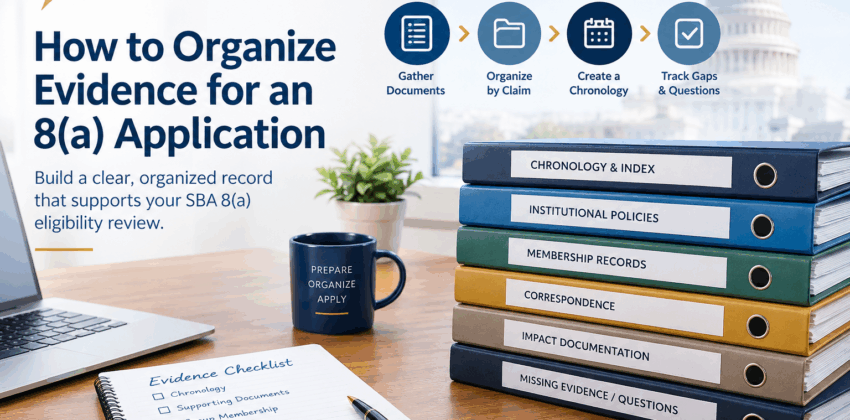
How to Organize Evidence for an 8(a) Application
October 26, 2026 | SBA 8(a) Certification
Learn how to arrange documents, build a clear chronology, and identify evidence relevant to SBA 8(a) social disadvantage reviews.

Why Evidence Organization Matters
A folder full of documents is not the same as a clear evidentiary presentation. Therefore, applicants should organize their materials around the eligibility requirements that the Small Business Administration (SBA) must evaluate.
For business owners exploring the SBA 8(a) Business Development Program, supporting evidence can help explain how personal experiences relate to the applicable requirements. In addition, the August 2026 rule describes a framework involving an identifiable group, individual membership, and material harm.
The following steps focus on practical preparation. However, they do not predict the outcome of an individual application or guarantee eligibility.
Step 1: Create a Chronology
Begin by arranging relevant events in chronological order. For each entry, record the date, describe the action or event, identify the people or institutions involved, and note the supporting records.
Next, create an evidence index that explains why each document matters. Use consistent filenames, preserve original records, and avoid changes that could make a document’s source or authenticity unclear.
Connect Events to Supporting Records
A short evidence summary can help explain how the documents relate to your account. More importantly, review whether the records support the applicable legal elements rather than simply showing that an experience was difficult.
By following a consistent process, business owners can identify relevant facts without losing important context. As a result, the chronology becomes a useful reference during document review.
Build a Clear Evidence Timeline
Follow these four steps to create a working chronology.
01
Record the Date
First, identify when the event, decision, or communication occurred.
02
Describe the Event
Next, summarize what happened using clear, neutral language.
03
Link the Record
Then, identify the document or source that supports the entry.
04
Review for Gaps
Finally, note missing information and questions that need further review.
This is a practical organization method, not an official SBA checklist.
Step 2: Organize Documents by Claim
Once you have created a chronology, group the supporting records by topic. For example, a working folder may contain institutional policies, group-membership records, personal correspondence, impact documentation, and the dated chronology.
These categories are organizational suggestions, not an SBA-mandated upload list. Therefore, include materials that are relevant to your circumstances and the applicable requirements.
Keep Each Category Clear and Relevant
Within each folder, arrange records by date and describe each source in neutral terms. This approach makes it easier to find specific documents during a review.
Keep in mind that one record may support a particular element while leaving another unresolved. For that reason, avoid assuming that a document proves more than its contents actually establish.

Example of a Working Folder Structure
You can adapt these folders to your situation. Remember, they are suggestions for organizing records, not official SBA submission categories.
SBA 8(a) Application Working File
├── 01 – Chronology and Evidence Index
├── 02 – Institutional Policies and Actions
├── 03 – Group and Membership Records
├── 04 – Personal Correspondence
├── 05 – Individual Impact Documentation
├── 06 – Missing Evidence and Open Questions
└── 07 – Final Review Copies
In addition, keep original files secure, use consistent filenames, and restrict access to sensitive personal or business information.
Step 3: Track Missing Evidence and Questions
An evidence index does more than list filenames. It can also explain the purpose of each record, identify the facts it supports, and flag areas that need clarification.
Separate Documented Facts from Interpretations
To begin, create a short fact sheet for each important record. Include its source, date, purpose, and limitations. This process helps you distinguish documented facts from your interpretation of events.
If a key connection cannot be supported, acknowledge the uncertainty rather than overstating the evidence. Similarly, note any additional context or information that may be needed.
Remember that a large volume of paperwork does not automatically make a claim stronger. Instead, focus on relevance, reliability, context, and the connection between each record and the applicable requirements.

Questions to Ask About Each Document
Before adding a record to your evidence index, consider the following questions:
- Source: Who created or supplied the record?
- Date: When was it created, received, or relevant?
- Purpose: What specific fact does it help establish?
- Limitations: What does the record not establish?
- Follow-up: Is any additional context or information needed?
Ultimately, this preparation method is not a substitute for the rule text or current SBA instructions. Since every application depends on its own facts, review the applicable eligibility criteria before submitting your materials.
Step 4: Review Your Evidence Before Moving Forward
After organizing the records, review how the information fits together. The following questions can help identify gaps and clarify the issues that may require further attention.
- Relevant action: What specific action or practice is at issue, and when did it occur?
- Group and membership: What reliable evidence identifies the affected group and my connection to it?
- Material harm: What material consequence can I substantiate, and how does it connect to the action?
If any answer remains unclear, identify the gap in your evidence index. Then, determine whether additional records, context, or professional guidance may help address the issue.
Key Takeaway
A well-organized application distinguishes group-level evidence, individual membership, and material harm.
However, examples and organizational methods should not be treated as automatic eligibility rules. Always check current SBA guidance before submitting materials.
In summary, start with a clear chronology, organize records around relevant issues, and maintain an evidence index. By identifying both supporting facts and unresolved questions, you can prepare a clearer record for review.
How LIBERTY8a Can Help
Preparing an SBA 8(a) application can involve detailed documentation and careful review. If you need assistance, contact LIBERTY8a to discuss its certification services.
Explore SBA 8(a) Certification Services
Visit
LIBERTY8a.com
for additional information.
No service can guarantee SBA approval.
Regulatory Reference
Federal Register, August 11, 2026, 91 FR 51568–51573.
Read the Federal Register publication
.